Digest · World Listens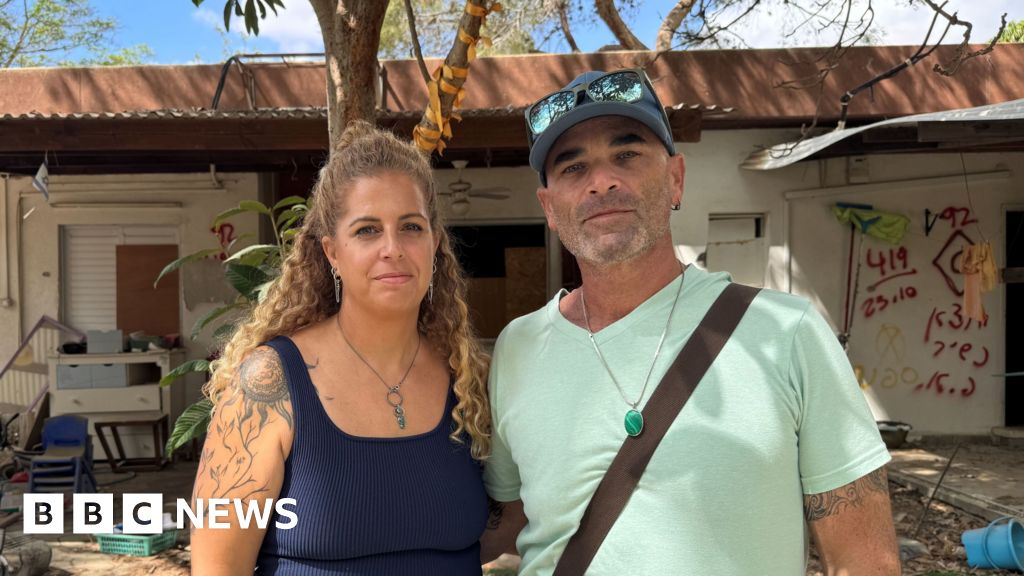
Site search 21 minutes ago Yolande Knell Middle East Correspondent, Kibbutz Nir Oz Roosting birds now coo among the ceiling tiles in the deserted dining room of Kibbutz Nir Oz, once the bustling heart of a close-knit, 400-strong Israeli community which was devastated by the Hamas-led attacks on 7 October 2023. "We used to come and see each other, eat together. There were lots of activities here, also holidays to celebrate," remembers Dalit Ram Aharon, who is showing me around with her husband, Achi.
By the glass entrance doors, dotted with bullet holes, there is a shocking reminder of what happened to the missing residents. The postboxes for each household bear stickers put there after the attacks three years ago: red indicates those killed, and black those taken hostage. "That's one out of four of us: murdered or kidnapped," Dalit says.
"Including children and babies." As Israel marks the third anniversary of its deadliest-ever day, this is another painful time of reflection for residents of the kibbutz, which sits just a mile (1.6km) from the Gaza border and was one of the worst-hit places. Time stands still at the nearby burnt-out house of the Siman Tov family, where a wind chime dangles by the door. A picture shows Tamar and Yonatan with their three children, twin girls Shahar and Arbel, five, and their two-year-old son, Omer.
The parents were shot through the door of their bomb shelter - designed to protect from rockets launched from Gaza, not gunfire. A red sticker on a postbox indicates those who were killed in the Hamas attacks; black indicates those who were taken hostage Dalit, who survived with Achi and their three children by hiding in their own shelter for nearly 12 hours that day, recalls the last social media messages sent by Tamar to her neighbours. "On that day in the morning, she wrote in the woman's group, at the beginning, 'Is everyone fine?' Then, at another point, she wrote, 'They are shooting us.' And after that she wrote with a lot of mistakes, 'We are very injured,'" Dalit tells me.
"From what we understand, they torched the house and the children died from suffocation, so all the family was killed." An estimated 500 Palestinians, led by Hamas's elite Nukhba force fighters, but including civilian looters, some of them children, joined the assault on the unsuspecting Nir Oz. Forty-one Nir Oz residents and foreign workers were killed, along with six people who had fled to the kibbutz from a party nearby. Seventy-six people from the kibbutz were kidnapped to Gaza, including nine bodies, with 14 hostages taken alive and killed in captivity.
The last living hostages from Nir Oz were returned to Israel on 13 October 2025 and the remains of the last deceased hostage, Amiram Cooper, were brought back two weeks later. As we walk through the greenery, it is eerily quiet bar bird song and the mewing of hungry, stray cats. Dozens of fire-damaged homes, which were simple, one-storey buildings in Nir Oz, have now been torn down, leaving just rows of the reinforced concrete safe rooms, which failed to keep people safe.
The Aharons want some damaged houses to be left as evidence of what took place. "We really support that," Achi says. "People should see what happened, should see the destruction, the pure hatred that happened here." The couple point out where a teacher, Maya Goren, was killed while in the kindergarten and the makeshift memorials where three of the seven members of the kibbutz security team were killed after battling Hamas gunmen.
The findings of the Israeli Defense Forces investigation into what happened at Nir Oz underscored how the army - left in a state of disarray by the unprecedented simultaneous assault on more than 20 communities and multiple military posts - completely failed to come to the rescue here. On 7 October, the first soldiers arrived in the kibbutz some 40 minutes after the last Palestinian attackers left. Nearly every household experienced killing, violence, including sexual assaults and rape, looting and kidnapping.
Dalit pauses to show me a tree planted long ago by her parents, who were co-founders of the kibbutz, known for its farming and peace activists. They survived the 7 October attacks physically unharmed but died just months afterwards. Next door is the small home of Shiri Bibas, the mother of ginger-haired boys Ariel, four, and nine-month-old, Kfir.
The three, snatched from their home, became symbols of the Gaza hostage crisis. "This is the hardest house for me because Shiri was a very, very good friend of mine," Dalit confides. "She was like a sister.
We even got pregnant together - me with my daughter and her with Ariel. They became best friends also. We used to laugh that they were going to marry." Courtesy of Dalit Ram Aharon Dalit says Shiri Bibas, who was killed along with her two children after being taken hostage, was "like a sister" "Shiri was very, very funny.
She was a happy person - a mother," Dalit says. "She lived a simple life. She never did anything to anyone." While Shiri's husband, Yarden, was released alive by Hamas in a Gaza ceasefire deal in February 2025, she and her sons - held by a different armed group - were killed.
Hamas blamed an air strike early in the Gaza war for their deaths, but Israeli forensic experts, who examined the bodies after they were returned later that February, said they were murdered by their captives and their bodies mutilated. Many of the bereaved from Nir Oz, including Yarden Bibas, have moved away for good. However, with 20 houses renovated or rebuilt, a few former hostages have come back to live here.
They include Gadi Moses, another kibbutz co-founder, and the oldest living male hostage released during the Gaza war, and Yair Horn, who stops to chat with the Aharons as he passes in a golf buggy. Dalit and Achi are determined to return too. "We'll come back for the memory of Shiri and for the people that didn't have the chance to live here, and for the memory of my parents, and to continue our roots, and for my children, because this is our home," Dalit says.
However, she, Achi and their children - currently displaced and living in an apartment in a town further north - face a two-year wait for Nir Oz to reopen fully. "Terrorists penetrated 97% of the households and burned down almost 50%," says Emi Palmor, director of the rebuilding project. "Now it's the only place in Israel that has to be completely demolished and completely replanned." She says that it is a difficult balance to redesign the kibbutz so that it feels like home but does not cause new trauma to those who return.
Emi Palmor is the director of the Reconstruction and Rehabilitation Project at Nir Oz "It's a huge debate – a very painful debate," Emi says. "Some people say, 'If I come back here, I want the entire area to look serene. I don't have to be reminded because I remember every day the people I lost.' Other people say, 'There is such denial – if we will take down the last houses, who will ever believe?'" About 1,200 people were killed and 251 taken hostage after an estimated 6,000 Palestinians streamed across the Gaza border during the attacks on southern Israel on 7 October 2023.
The ensuing war between Israel and Hamas has killed more than 74,200 people in Gaza, according to the Hamas-run health ministry, whose overall figures are seen as accurate by the UN. Despite the US-brokered ceasefire deal which brought the last hostages home a year ago, violence has continued, including near-daily Israeli attacks on Gaza. Nearly all of Gaza's 2.1 million population has been displaced and much of the territory is in ruins.
US President Donald Trump's peace plan is at an impasse. For Israelis, there are outstanding questions over accountability for the failure of Israel's security forces to have prevented the 7 October attacks. People from Nir Oz favour a comprehensive state commission of inquiry and still have major security concerns.
Survivors, including the Aharons, suffer from post-traumatic stress. Dalit recalls how her eldest son, Uri, turned nine on 7 October 2023 - when they spent the day hiding in their bomb shelter. "He told me, 'Mum, I don't want to die on my birthday,'" she says.
"You know people don't understand that we still live this horrible day." This anniversary of the attacks is the first with no hostages remaining in Gaza. "It's a very big relief," Dalit says. Achi sees that now is the time to focus on personal healing.
"Until the hostages came back, it was the only thing on our mind," he says. "Now you have the time to concentrate on yourself, on what you lost, what you need. Now it's our recovery or some kind of recovery as much as we can." More on this story
Source: BBC